
Appeal Court halts deregistration of ADC, four other parties, faults trial Judge. By Abibu Shehu Ibrahim
Appeal Court halts deregistration of ADC, four other parties, faults trial Judge.
By Abibu Shehu Ibrahim
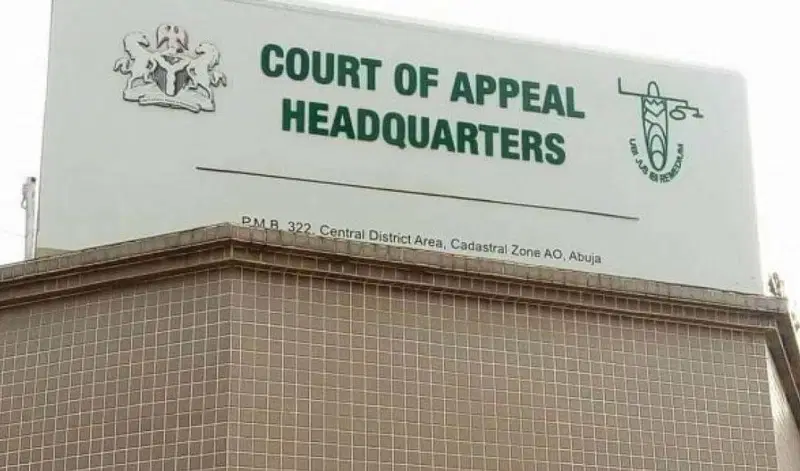
Five political parties, including the African Democratic Congress (ADC), have secured a temporary reprieve after the Court of Appeal in Abuja stayed the execution of a Federal High Court judgment directing the Independent National Electoral Commission (INEC) to deregister them.

In a unanimous ruling delivered on Tuesday, a three-member panel led by Justice A. B. Mohammed faulted Justice Peter Lifu of the Federal High Court, Abuja, for proceeding with the case despite an earlier order of the appellate court directing him to suspend proceedings.
The panel described his action as one of the gravest forms of judicial misconduct.
“The decision of the lower court to proceed with the judgment despite the express order of this court is a brazen violation of the hierarchy of courts and the provisions of the 1999 Constitution,” the panel held.

The appellate court further relied on a Supreme Court precedent to characterise Justice Lifu’s conduct in the strongest possible terms.
“The decision of the lower court to proceed with the judgment despite the express order of this court amounts to the highest form of judicial impertinence,” the panel declared.
It added that the Supreme Court had previously held that a judge who acts in such a manner “is unfit for the bench as it amounts to judicial rascality.”
The court stressed that it had a duty to uphold its supervisory authority over lower courts and safeguard the integrity of the judicial system.
“Courts are enjoined to protect their integrity.
This court exercises supervisory authority over the trial court and has a duty to ensure that its orders are obeyed.
Accordingly, the application for stay of execution is granted, and the enforcement of the judgment is hereby stayed,” the panel ruled.
Earlier, INEC informed the court that it was taken aback by Justice Lifu’s decision to deliver the judgment, revealing that the commission only became aware of the ruling through media reports rather than any official communication from the court.
INEC’s lead counsel, Mr Haliru Mohammed, told the panel that the commission was aware of the Court of Appeal’s May 22 order restraining the lower court from delivering the judgment, which had initially been scheduled for June 5.
“We were not aware of any notice from the court regarding the delivery of the judgment.
“We only learnt of it through breaking news reports in the media. Consequently, we do not oppose the appellant’s application for a stay of execution,” Mohammed submitted.
The commission also aligned itself with the notice of appeal filed by the affected political parties.
Counsel to the ADC, Mr Shuaibu Aruwa, SAN, informed the court that Justice Lifu communicated the date for the judgment’s delivery to the party through WhatsApp, a disclosure that reportedly drew visible reactions from members of the appellate panel.
Aruwa described the trial court’s conduct as an invitation to anarchy and urged the Court of Appeal to invoke its disciplinary powers under Section 6 of the 1999 Constitution to sanction the judge.
“The action of the trial judge calls for swift and extraordinary intervention from this court.
“We have reached a stage where this court must press the reset button,” Aruwa submitted.
“We urge this court to take disciplinary measures by immediately suspending the judgment.
This court has the authority to protect its own integrity, and we pray that the judgment be suspended without further delay,” he added.
Other affected parties also drew the court’s attention to the June 20 by-elections scheduled across six states, warning that allowing the judgment to stand could trigger serious electoral and constitutional crises across the country.
The Federal High Court had ordered INEC to deregister the ADC, alongside the Action Peoples Party (APP), Action Alliance (AA), Accord Party, and Zenith Labour Party (ZLP), on the grounds that the parties failed to meet the constitutional requirements for continued existence and participation in future elections.
However, with Tuesday’s ruling by the Court of Appeal, the five political parties will remain registered pending the determination of their appeals.