

Titles Without Territory: The Alaafin and the Limits of Legacy By Olaitan Adesina

Titles Without Territory: The Alaafin and the Limits of Legacy
By Olaitan Adesina
There is a common temptation, in societies with long memories, to mistake survival for supremacy and ritual continuity for political relevance. Nowhere is this more evident than in the recurring effort by some voices to speak of the Oyo Empire as though it were merely dormant,and waiting to be reactivated through mere wishful thinking.

History is less sentimental. History is not interested in your emotions. History is about facts.
The fact is that the Oyo Empire ended in 1835. Not only metaphorically and administratively. It ended materially, militarily, and irreversibly with the fall of Oyo-Ile. What survived was not an empire, but a stool, stripped of its territorial reach, its coercive power, and its authority over “Yorubaland”. I put Yorubaland in quotes because the current geographical entity known as Yorubaland is not the same Yorubaland that Oyo dominated.
This distinction matters.

The Alaafin of Oyo today presides over a historic kingship, not an imperial system. His authority is merely symbolic and cultural, and largely restricted to the town of Oyo, and perhaps a few surrounding villages. He inherits memory, not machinery. And while memory commands respect, it does not confer jurisdiction over cities that rose after the empire collapsed, nor over institutions that were forged in entirely different historical conditions.
After 1835, the political centre of gravity in Yorubaland shifted decisively. New forces emerged. Most notable of such was Ibadan, a city born not of mythology but of necessity, organisation, and military discipline. Ibadan did not inherit legitimacy; it earned dominance. It imposed order where Oyo’s imperial authority had evaporated and became, for much of the nineteenth century, the decisive power in the Yoruba interior.
Colonial rule did not restore Oyo’s empire. It did not even attempt to. Instead, it froze the Alaafin’s title in clay, while engaging Ibadan as a practical centre of governance. This was not an accident. Administrators, like historians, recognise power where it actually resides.
The modern Nigerian state has continued this logic.
Today, the Alaafin is accorded honour because of what Oyo once was, not because of what it currently controls. His voice carries cultural weight, not administrative command. His influence depends on persuasion, not reach. To insist otherwise is to deny nearly two centuries of political evolution.
It is therefore unhelpful and historically careless for Alaafin Owoade and his supporters to invoke the Oyo Empire as a living political entity, or to suggest that contemporary Yoruba cities exist under Oyo’s residual imperial shadow. Empires do not linger on vibes and insha Allah. They persist through institutions, armies, and systems of extraction. Oyo lost all three in the nineteenth century.
What remains is dignity. And dignity, if properly understood, does not require exaggeration.
The strength of the Alaafin’s stool lies precisely in its acceptance of limits and in embodying tradition without pretending to command a polity that no longer exists. When symbolic authority attempts to overreach into arenas shaped by population, economics, and modern governance, it exposes anxiety instead of strength. What is Alaafin Owoade afraid of?
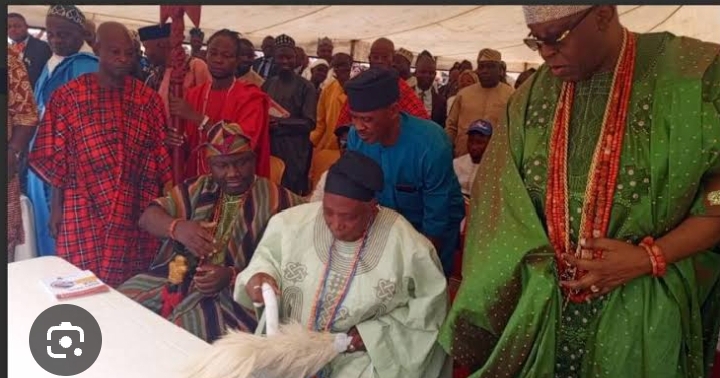
At a recent event, the Alaafin, with his taste for grandeur and self-importance, reached out for a handshake from the Olubadan and was quietly ignored. No drama. No argument. Just a hand left hanging in full view of cameras and witnesses. In Yoruba public life, that is not a minor slight; it is a sentence. The Olubadan did not insult the Alaafin, he simply declined to play along. And in doing so, he reminded everyone present that arrogance does not command obedience, and that no amount of ancestral boasting can force respect in the absence of contemporary relevance.
History has already spoken.
Oyo was once supreme.
Ibadan became powerful afterward.
Nigeria now governs both.
To acknowledge this is not to diminish Oyo; it is to place it correctly in time. And time, unlike titles, cannot be negotiated.
_Olaitan Adesina is the author of Agidigbo – Soliloquy in Verse. He writes from Akure, Nigeria._