Gov Diri Sacks Bayelsa United Board, Coaches After Relegation Also Signs PWDs, BMUTH Bills Into Law. By Chris Mark
Gov Diri Sacks Bayelsa United Board, Coaches After Relegation
Also Signs PWDs, BMUTH Bills Into Law
Bayelsa State Governor, Senator Douye Diri, has dissolved the board of Bayelsa United Football Club and sacked the entire technical crew following the team’s relegation from the Nigeria Professional Football League (NPFL) to the Nigerian National League (NNL).
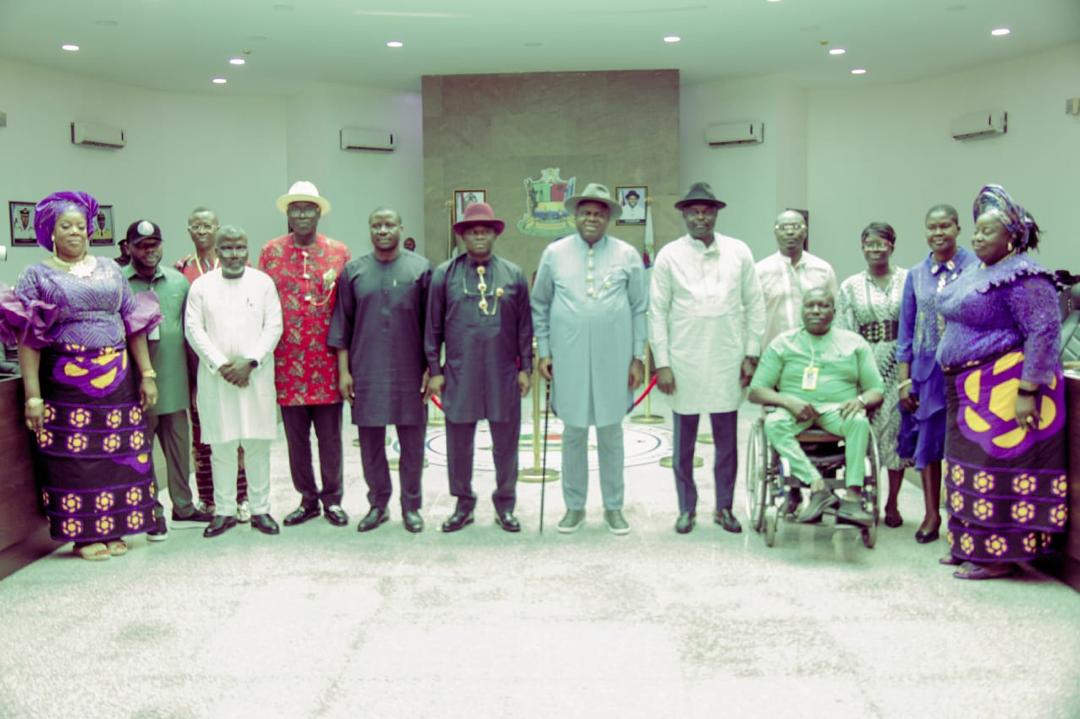
The governor announced the decision on Wednesday during the 188th State Executive Council meeting at Government House, Yenagoa.
He said an interim management would be constituted to oversee the team’s reorganisation and facilitate its immediate return to the top flight of Nigerian football.
Governor Diri directed that all affected board members, coaches, and officials hand over the club’s property in their possession to the Commissioner for Sports Development without delay.
At the same meeting, Governor Diri also assented to two key bills — the Persons With Disabilities (PWDs) Bill and the Bayelsa Medical University Teaching Hospital (BMUTH) Bill.
A statement by his Chief Press Secretary, Mr. Daniel Alabrah, quoted the governor as describing the PWDs legislation as “profound” and “the people’s law,” saying it guarantees dignity, equal opportunity, and fair treatment for all Bayelsans regardless of physical condition.
He commended Dr. Charles Daniel, member representing Brass Constituency I and sponsor of the bill, for his persistence, calling it one of the best pieces of legislation from the State House of Assembly.
“I had directed the Deputy Governor, when he was Chief of Staff, to initiate an Executive Bill that would take care of our brothers and sisters living with disability. I was later informed there was already a private member bill sponsored by Dr. Daniel, and so I directed the executive arm to work with him. That is the product we have today,” Diri said.
He lauded the Speaker, Rt. Hon. Abraham Ingobere, and members of the Assembly for the speedy passage of the bill, noting that the law would address the exclusion of persons with disabilities from public and private infrastructure.
“For me, this is one of the best pieces of legislation that has come out of the State House of Assembly. I commend the very hardworking Speaker for giving very quick attention to this bill and passing it with the speed of light,” he added.
The governor noted that PWDs in the state had already recognized government interventions even before the law, stressing that his administration’s performance would not be measured by physical projects alone.
“We often build houses and public infrastructure without considering the entrance and parking spaces for our brothers and sisters with disability. I’m happy that the chairman of the PWDs association has acknowledged most of what this government has been doing to ensure we do not leave them out,” he said.
The new law is expected to strengthen protection, access, and inclusion for PWDs in the state.
Speaker Ingobere said the PWDs Agency Bill had its first reading on October 15, 2024, and was passed on March 18, 2026. The agency will have a part-time chairman appointed by the governor and a Director-General, who must be a person with disability, to oversee daily operations.
He added that the agency would ensure public transport, parking lots, and buildings are accessible to persons with disabilities. One out of 10 seats in public buses will be reserved for physically challenged persons, while suitable spaces will be marked and reserved for them in public parking lots.
Chairman of the Joint National Association of Persons With Disability, Bayelsa State Chapter, Mr. Mayor Doutiminariye, thanked the governor for what he described as a “miracle,” saying Diri had ensured from the inception of his administration that physically challenged persons enjoy protection and recognition.
On the BMUTH Bill, Governor Diri said the law ends years of debate over the need for a second teaching hospital in the state.
“So, from today we have established a teaching hospital, an institution of its own for the medical university. There was a time we even debated in this chamber whether it is economically wise to have two teaching hospitals, because we already had the Niger Delta University Teaching Hospital,” he said.
He insisted the decision was based on necessity: “We cannot have a medical university without a teaching hospital.”