Women Must Move Beyond Inclusion to Leadership, Transformation- Tajudeen, Akeredolu …as Oshiomhole urges judiciary to remain true last hope of common man By Saheed Badmus
Women Must Move Beyond Inclusion to Leadership, Transformation- Tajudeen, Akeredolu
…as Oshiomhole urges judiciary to remain true last hope of common man
By Saheed Badmus


The Chairperson of the House of Representatives Spouses Association, Hajiya Fatima Tajudeen, has urged women privileged to serve in public and political offices to use their positions to improve lives, speak for people without access to the corridors of power and leave institutions stronger than they found them.
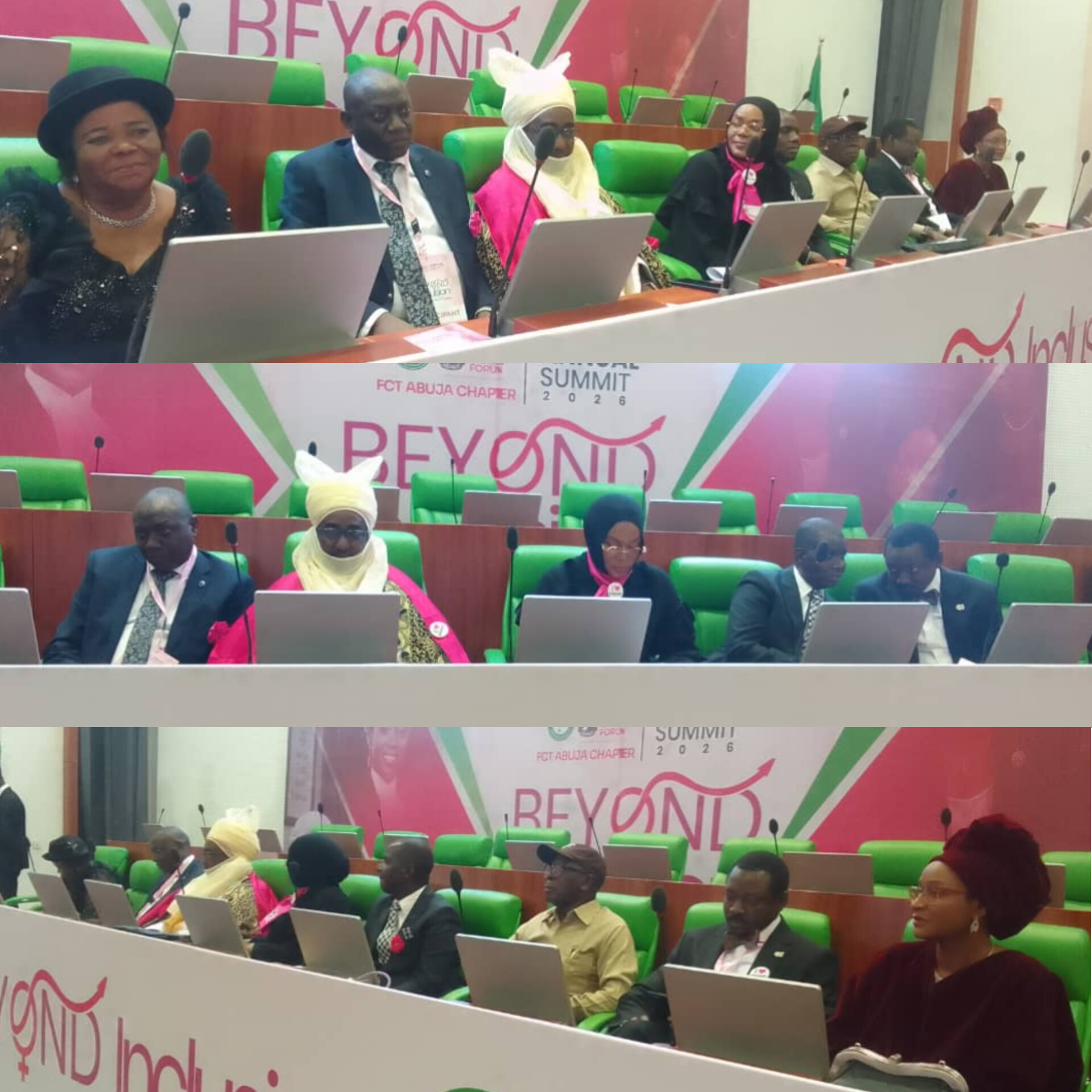
Tajudeen, represented by Hon. Blessing Amadi, gave the charge in Abuja at the maiden annual summit of the Nigerian Bar Association Women Forum, FCT Chapter, led by Ambassador Hadiza Afegbua, with the theme, “Beyond Inclusion: Writing the Next Chapter,” which she described as timely and thought-provoking.
She said the conversation on women’s participation must now move beyond simply ensuring their presence in politics, governance, business, the professions and decision-making. “It is one thing for a woman to be present in the room. It is another for her voice to be heard,” she said, stressing that meaningful participation requires women to influence decisions affecting their communities and the country.
Tajudeen who noted that women constituted roughly half of Nigeria’s population, yet their representation in political institutions remained disproportionately low, with women accounting for fewer than five per cent of members elected to the National Assembly after the 2023 general elections, maintained that the disparity should concern everyone because a nation functions best when it draws on the abilities, experiences and perspectives of its entire population.
She said the barriers confronting women were not always legal, but could be economic, cultural and institutional, while political and professional systems developed over the years could also create obstacles. “The next chapter cannot simply repeat the conversations of the previous chapter. It must move us towards practical action,” she said, calling for deliberate development of female talent, mentorship, sponsorship, networks and opportunities.
According to her, women who had crossed barriers must help others to do the same, particularly those already occupying positions of influence. “Representation is not merely about occupying a seat. It is about using that seat to improve lives, to speak for people who may not have access to the corridors of power, and to leave institutions stronger than we found them,” she said.
While delivering her keynote address, former Commissioner for Justice and Attorney General of Ogun State, Mrs. Abimbola Akeredolu, said the summit’s theme challenged stakeholders to move from participation to transformation and from occupying seats at the table to shaping the agenda of the table itself. She asked who would write the next chapter of the legal profession, define its values, shape its institutions and determine what justice should look like in a rapidly changing society.
Akeredolu said women had made significant progress in the legal profession, noting that Nigeria had produced two female Chief Justices of the Supreme Court, while women had also risen to become heads of prestigious law firms, Attorneys-General, corporate executives, arbitrators, academics, legislators and policymakers. “Nigerian women and women lawyers have demonstrated excellence that commands respect, not because they are women, but because they are exceptional professionals,” she said.
She argued that inclusion should no longer be treated as the final destination, but as a doorway to broader institutional transformation. “What comes after inclusion? How do we move from participation to influence, from representation to transformation, from occupying spaces to shaping the future of those spaces? That is the next chapter that we are here to advocate,” she said.
Akeredolu said the next chapter should not be about fitting women into systems designed without them in mind, but redesigning institutions to reflect the talent, perspectives and leadership women bring. She called for institutions that reward competence, integrity, innovation and service, while ensuring that leadership opportunities were not only accessible but sustainable.
Earlier, the State Lead, NBA Women Forum, FCT Chapter, Ambassador Hadiza Afegbua, described the summit as an important milestone and the beginning of a deeper conversation on the future of women in leadership, the legal profession and Nigeria. She said the objective was to move beyond inclusion to influence, leadership and impact, ensuring that women had the authority and capacity to shape decisions affecting society.
Afegbua said the summit brought together stakeholders from government, the judiciary, legislature, Bar, academia, business and civil society because lasting change required collaboration. She particularly called for greater support for young female lawyers through mentorship, sponsorship, transparent recruitment, leadership development and workplaces where merit, excellence and dignity were upheld.
She said public policy also had a critical role in creating opportunities for the next generation of professionals, noting that the summit’s policy discussion on the Special Seats Bill would provide an avenue for stakeholders to engage issues shaping democracy and the justice system.
“This Summit is not intended to end with conversations alone. We want conversations that lead to recommendations, recommendations that inspire partnerships, and partnerships that produce measurable change,” she said.
In his address, Chairman of the Senate Committee on Interior, Senator Adams Oshiomhole, expressed excitement over the elevation of women to top positions in the judiciary and other public and private sectors. He, however, urged stakeholders to ensure that the judiciary lived up to its traditional description as the last hope of the common man, questioning whether ordinary Nigerians truly had meaningful access to justice.
Oshiomhole recalled his advocacy for the protection of lawyers and the rule of law, citing the unresolved killing of a former President of the Anambra Branch of the Nigerian Bar Association and his pregnant wife as an example of the insecurity and injustice that could affect members of the legal profession. He also referenced concerns over unresolved high-profile killings, arguing that denial of justice to any Nigerian should be regarded as a collective deprivation.
The Senator said the struggle for justice must transcend partisan or political interests, insisting that every citizen’s rights deserved protection. “The struggle for justice should not be something that is limited to political beefings. Whenever we see any Nigerian, known or unknown, denied justice, I think each and every one of us should feel a sense of deprivation,” stressing that Nigeria’s democracy would become stronger when leaders and citizens recognised that individual rights must be respected and protected.