
A Night of Blasts Across Capitals in the Middle East
A Night of Blasts Across Capitals in the Middle East
The United States and Israel launched what officials described as one of the largest coordinated air operations in recent history against Iran on Saturday, with Iranian authorities reporting that more than 200 people were killed and over 700 wounded in the strikes.
Tehran responded with a sweeping missile barrage that sent residents scrambling for shelter across multiple countries in the Middle East, marking a dramatic escalation in regional tensions.

Authorities in the Islamic Republic of Iran urged residents to evacuate parts of the capital, a city of nearly 10 million people. The Iranian Red Crescent confirmed that 201 people had died, with hundreds more injured. The judiciary claimed that a strike on a school in southern Iran killed 85 people, though independent verification of that figure was not immediately possible.
Gulf States Feel the Impact
The United Arab Emirates reported one civilian fatality and infrastructure damage in both Dubai and Abu Dhabi as missiles from Iran’s retaliatory response crossed regional airspace. Explosions and air defence interceptions were also reported over Israel, Saudi Arabia, Bahrain, Qatar, Jordan, and Kuwait.

In the weeks preceding the attack, Tehran had repeatedly warned it would respond forcefully to any military action. Foreign Minister Abbas Araghchi stated that US and Israeli installations involved in the operation were “legitimate targets.”
Iran’s Revolutionary Guards announced that the Strait of Hormuz had been closed, according to the European Union’s naval monitoring mission, raising concerns about global oil supply disruptions.
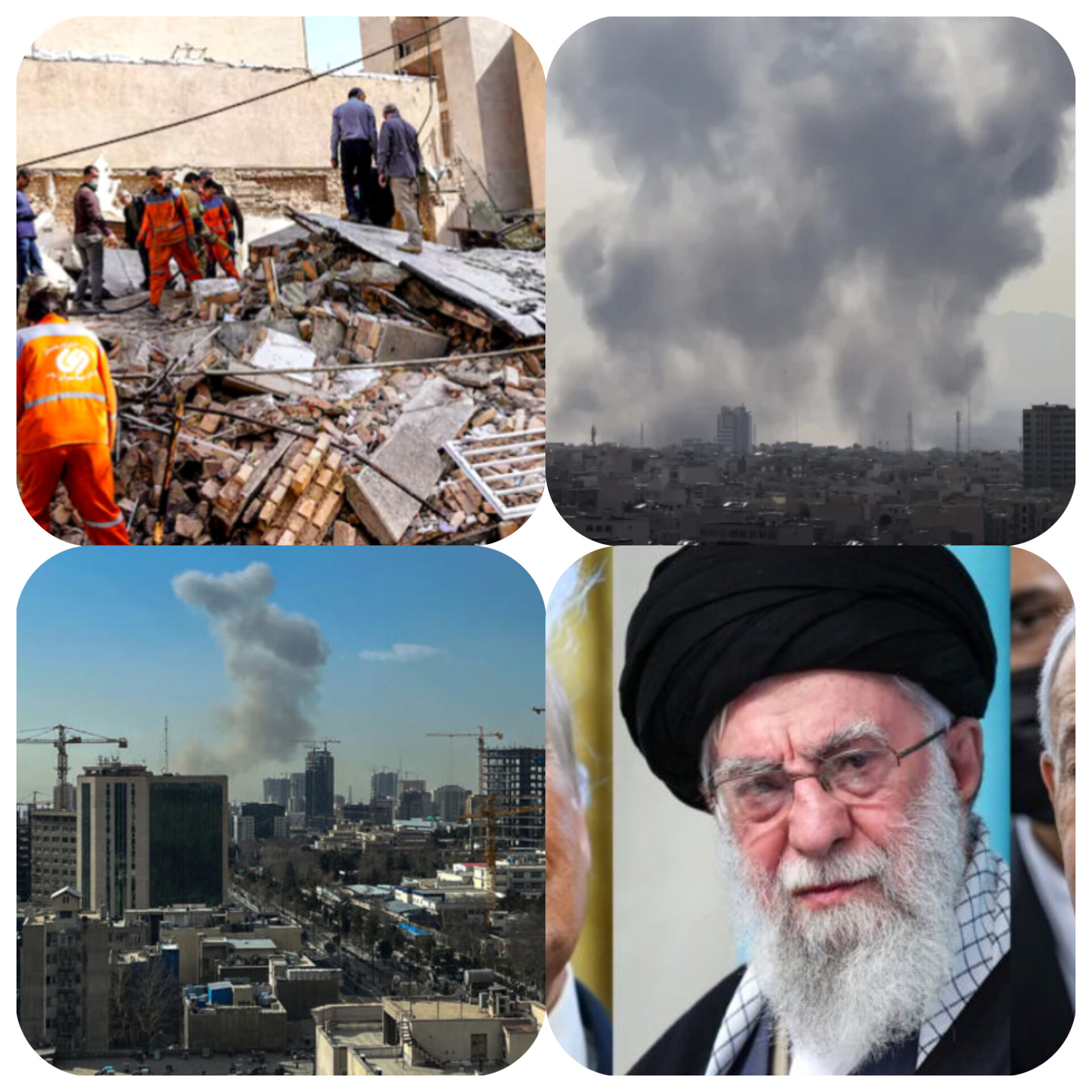
Thick smoke was seen rising over parts of Tehran, including the Pasteur district, where Supreme Leader Ayatollah Ali Khamenei resides.
Israeli media reported that both Khamenei and President Masoud Pezeshkian were targeted. However, Araghchi told NBC News that Khamenei was alive “as far as I know,” adding that “all high ranking officials are alive.” Foreign ministry spokesman Esmail Baqaei later told the BBC he could not confirm details regarding Khamenei’s condition but emphasised national unity in defence efforts.
An Israeli military official stated that several senior Iranian figures were “eliminated” during strikes on gatherings of officials.
Streets Empty, Sirens Wail
In Tehran, daily routines were abruptly halted. Security forces deployed heavily across the city as businesses shut their doors and residents sought safety indoors. Communications disruptions and internet outages were reported.
“I saw with my own eyes two Tomahawk missiles flying horizontally toward targets,” a Tehran office worker said before connectivity was cut.
The Red Crescent confirmed that 24 of Iran’s 31 provinces were affected.
President Masoud Pezeshkian condemned the reported strike on a girls’ school as a “barbaric act.”
Across Israel, streets were largely deserted as citizens took shelter from incoming missiles. Emergency services reported two injuries linked to intercepted projectiles.
‘Eliminating Imminent Threats’
US and Israel strike Iran
US President Donald Trump said Washington’s objective was “eliminating imminent threats” tied to Iran’s nuclear and missile programmes. Israeli Prime Minister Benjamin Netanyahu described the operation as necessary to remove what he called an “existential threat.”
“We are going to destroy their missiles and raze their missile industry to the ground,” Trump said, adding a direct appeal to the Iranian public to “take over your government.”
It marked the first US military action of this magnitude aimed at destabilising a foreign government since the 2003 invasion of Iraq.
Israel’s military chief, Lieutenant General Eyal Zamir, said the operation was unfolding “at a completely different scale” compared to the 12-day conflict between Israel and Iran in June.
According to the Israeli military, approximately 200 fighter jets carried out extensive strikes targeting missile infrastructure and defence systems in western and central Iran, describing it as the largest air raid in the history of the Israeli Air Force.
Iran’s Revolutionary Guards claimed their missiles and drones struck the headquarters of the US Navy’s Fifth Fleet in Bahrain, as well as American bases in Qatar and the United Arab Emirates, alongside military sites in Israel.
In response to the escalating hostilities, Iran, Iraq, Kuwait, Syria, the UAE, and Israel partially or fully closed their airspaces. Several international airlines suspended flights to and from the region.
Residents in Doha, Abu Dhabi, Manama, and other Gulf capitals reported hearing multiple explosions as defensive systems intercepted incoming missiles.
In Qatar, a missile reportedly struck a residential area, igniting a fireball upon impact.
In Abu Dhabi, witnesses described seeing numerous projectiles streaking across the night sky.
In Bahrain’s capital, Manama, authorities evacuated residents from the Juffair district, home to the US Navy’s Fifth Fleet.
“When we heard the sounds, we cried out of fear,” said Jana Hassan, a 15-year-old student present in the area. “I will never forget the sound of those loud blasts.”
In Dubai, witnesses reported smoke rising from The Palm, a prominent man-made island development, with officials confirming four injuries.
Oman’s foreign ministry, which has previously mediated US-Iran discussions, called on all sides to halt military operations immediately and urged the UN Security Council to enforce a ceasefire.
What You Should Know
The coordinated strikes by the United States and Israel mark one of the most significant escalations involving Iran in decades, triggering widespread retaliatory attacks across the Gulf.
Civilian casualties have been reported in multiple countries, and strategic routes such as the Strait of Hormuz are now under threat. Airspace closures and flight cancellations have disrupted regional travel, while global leaders are urging restraint.
With conflicting casualty reports and claims of targeted senior officials, the full impact of the operation remains uncertain as diplomatic and military tensions continue to unfold.