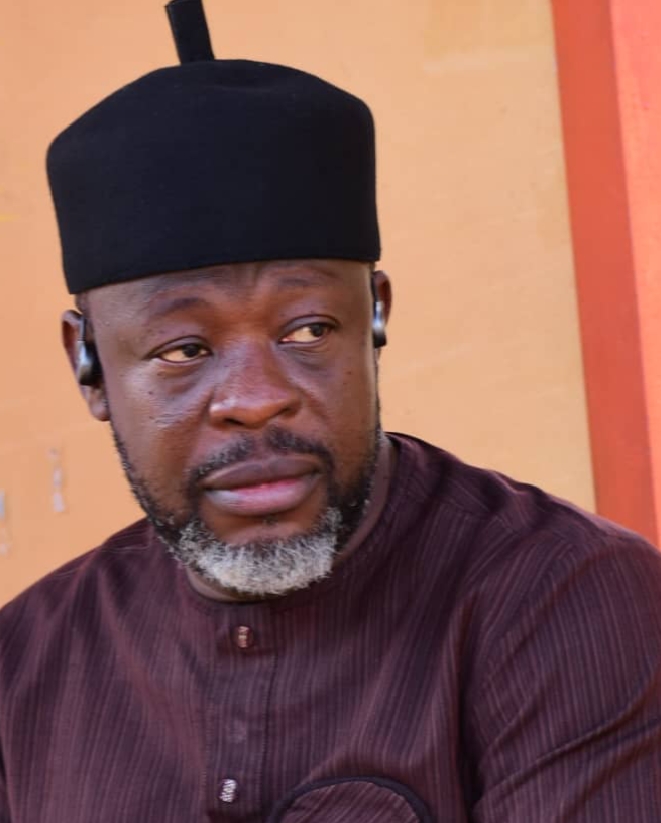

A Sovereign Shrug in the Face of a Distant Roar _For Nigerians Who Need No Foreign Savior_. By Chidi Ekeh

A Sovereign Shrug in the Face of a Distant Roar
_For Nigerians Who Need No Foreign Savior_
Let us begin with the obvious, so obvious it should not need saying: the loudest dog in the village is not always the one guarding the gate. Sometimes it is only barking at its own shadow, startled by the holes in its own fence. Donald Trump’s weekend threat to “come in guns-a-blazing” to rescue Nigerian Christians is precisely that kind of noise—an echo bouncing off the walls of his political loneliness, searching for an enemy that will make his own people forget the enemies within.

Nigerians should not squander precious anger on a man who is no longer even the most powerful person in his own living room. The United States Constitution has already term-limited him out of the Oval Office; the only oval he now commands is the television screen where he watches himself in replay. Whatever artillery he imagines aiming at our forests exists mostly in the same realm where he once forecast that bleach might cure a virus—an realm of make-believe mighty enough to fool the gullible, yet flimsy enough to collapse at the first touch of reality.
Yes, the video clip ricocheted across WhatsApp groups, from Jos beer parlours to Lekki salons, igniting arguments louder than the fuel-queue quarrels at NNPC stations. Some compatriots heard the threat and felt the old colonial tremor—“not again.” Others heard it and felt a strange flush of pride— “finally, someone notices.” Both reactions are understandable; neither is necessary. Trump is not Cecil Rhodes with a charter, nor is he an avenging archangel. He is a retired showman hunting for a new stage, and Nigeria has enough real dramas without importing his matinée.
Consider the timing. On the very day Trump vowed to save us, a U.S. federal court was unsealing fresh filings about classified documents found in his Florida bathroom. Consider the audience. He spoke not to the United Nations, not to Congress, but to a Christian broadcasting network whose viewers fervently believe the Rapture could happen before the next commercial break. When a man’s own house is on fire, he will sometimes point at a neighbour’s chimney and yell “smoke!” so that the neighbourhood looks away from the flames climbing his curtains. Nigeria is that convenient neighbour today.

We have genuine wounds; no patriot denies them. From Zamfara to Benue, from Borno to Ondo, bullets and blood have carved too many fresh graves. Yet the answer to those wounds will never arrive on the cargo hold of a foreign aircraft whose pilot cannot pronounce “Ogbomosho,” whose manifest mistakes Shiites for shea butter, whose map marks the Niger Delta as “the oil part.” Our healing must be brewed here, bitter as agbo, strong as ogogoro, complex as jollof at a Lagos wedding where every auntie has brought her own secret spice. It will involve village-square dialogue, state-police reform, judicial courage, and a thousand town-hall meetings that no cable news anchor will ever live-stream. It will not be solved by a reality-TV president auditioning for a second season that the American electorate already cancelled.
So what do we do with the heat? First, we laugh—because laughter is sovereignty’s antiseptic. Laugh at the absurdity of a man who could not keep his own Capitol safe promising to police our savannah. Laugh at the meme of Trump riding a Lagos okada in borrowed agbada, GPS in one hand, megaphone in the other, asking for directions to Sambisa. Laughter does not mean indifference; it means we refuse to grant a distant narcissist the power to set our pulse rate.
Second, we look inward, not outward. The best reply to foreign interference is domestic progress. Every governor who pays salaries on time, every judge who refuses a bribe, every imam and pastor who denounces violence from the pulpit, every tech kid in Yaba who codes a farmer-market app that bypasses the middleman—each is a more potent guardian of sovereignty than any imported cavalry.
Third, we talk to one another—calmly. The Muslim farmer in Kebbi and the Christian banker in Enugu share the same naira tumbling against the dollar, the same queue for passports, the same hope that their children will not need to japa. If we allow a retired American landlord to redraw our battle lines, we insult the intelligence of our own diversity.
And finally, we remember history’s small print: no outside power has ever solved an inside problem it did not first magnify for its own benefit. Vietnam, Afghanistan, Iraq, Libya—the graves in all those places are fertilised by salvations that arrived armed and left armless. Nigeria is not yet a perfect poem, but it is our poem still being written. We will not outsource the next stanza to a ghost-writer who cannot spell our names.
So let the barking dog bark. The caravan of 220 million souls moves on, barefoot sometimes, yes, but beneath skies our ancestors negotiated long before any star-spangled banner was sewn. The drums that guide our steps are local drums; their rhythm is ours to refine. And when night falls, we will settle our quarrels the way we always have—under the mango tree, with kola nut, with debate, with the stubborn belief that tomorrow’s Nigeria can be better than yesterday’s, not because a foreign saviour said so, but because we, despite everything, still choose to believe in ourselves.
That, fellow citizens, is the only rescue mission worth boarding.
Ekeh Chidiebere writes on national identity, leadership and the rebirth of civic consciousness in Nigeria.