

Rivers Impeachment Plot Is Political Banditry, Threatens Nigeria’s Democracy — CNPP, Civil Society Warn. By Lai Gidado
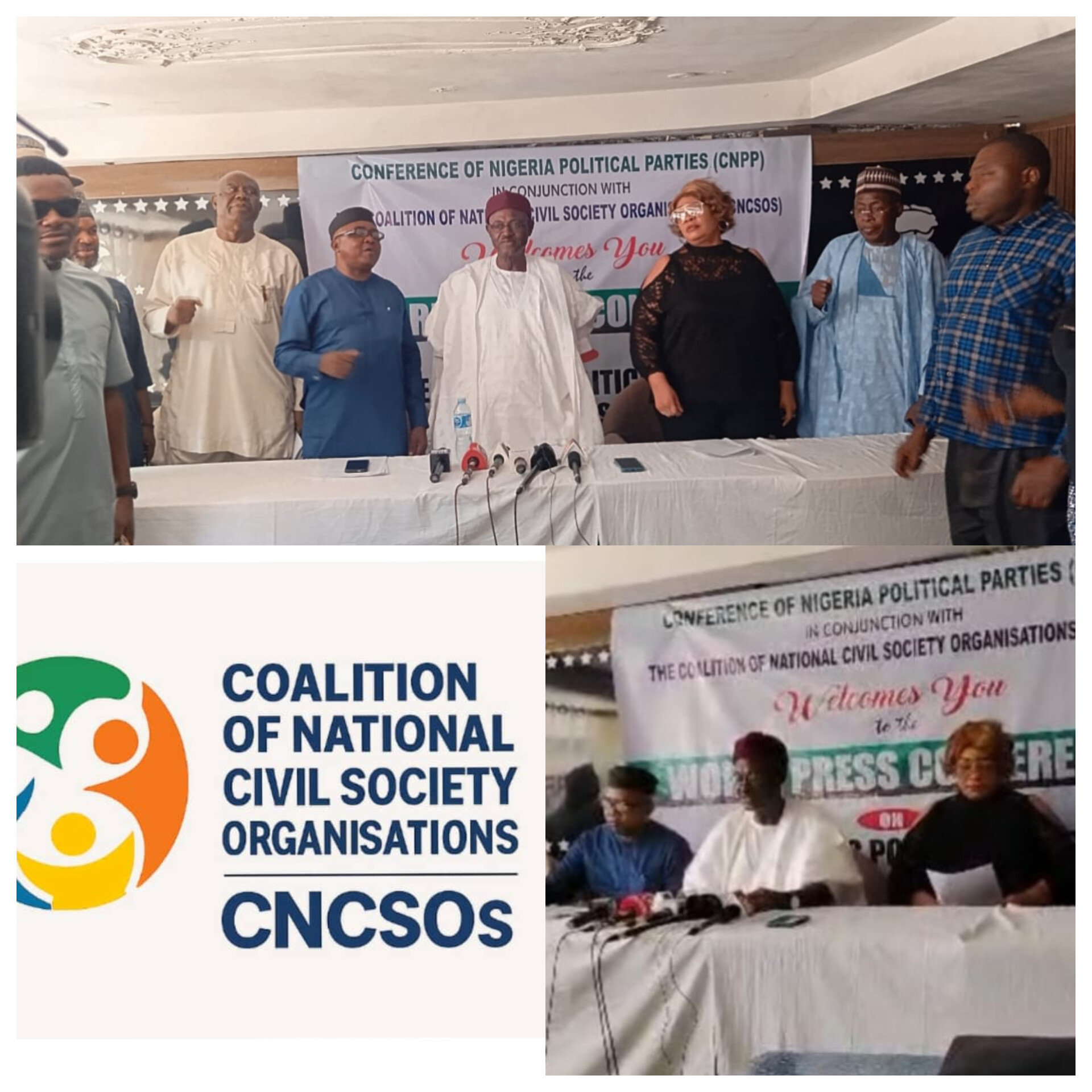
Rivers Impeachment Plot Is Political Banditry, Threatens Nigeria’s Democracy — CNPP, Civil Society Warn
The Conference of Nigeria Political Parties (CNPP) and the Coalition of National Civil Society Organisations (CNCSOs) have issued a stark warning that the ongoing political crisis in Rivers State represents a serious threat to national peace, constitutional governance, and Nigeria’s still-consolidating democracy.
Addressing journalists at a joint press conference read by Baba Abubakar El-Nafaty, Chairman of the Elders Forum of the CNCSOs, the groups said their intervention was compelled by what they described as a “solemn patriotic duty to defend constitutional democracy, protect the mandate of the people of Rivers State, and avert a dangerous political precedent.”
“What is unfolding in Rivers State goes far beyond local politics,” the groups declared. “It represents a critical test of Nigeria’s commitment to constitutional governance, separation of powers, and democratic stability.”
Tracing the roots of the crisis, the CNPP and CNCSOs insisted that the turmoil did not arise from any failure of governance or constitutional breach by Governor Siminalayi Fubara. Rather, they said it was “the product of a calculated political project aimed at seizing control of state power through the manipulation of legislative institutions.”
They recalled that Rivers State had already endured a six-month emergency rule during which democratic governance was suspended, adding that Nigerians had expected stability and reconciliation after Governor Fubara’s return to office. “Instead,” they said, “the state has been thrown back into turbulence through renewed impeachment threats, suggesting a deliberate strategy to keep Rivers State in perpetual political uncertainty.”
The organisations were emphatic that there is no constitutional basis for the impeachment moves against the governor. “Let us be clear,” they stated, “Governor Siminalayi Fubara has not committed any act that meets the constitutional threshold for impeachment under Section 188 of the 1999 Constitution, as amended. There is no credible allegation of gross misconduct, no paralysis of governance, and no popular uprising demanding his removal.”
According to them, what is playing out is “the weaponisation of a State House of Assembly as an instrument of political conquest rather than a guardian of democracy.” They warned that this development is “not only reckless; it is extremely dangerous to Nigeria’s national peace.”
The CNPP and CNCSOs cautioned that if the Rivers State scenario is allowed to stand, the consequences would be far-reaching. “If the Rivers State template is allowed to stand—where a legislature is openly deployed to intimidate, destabilise, and remove a sitting governor for political and financial control—then Nigeria risks sliding into a future where state assemblies across the country become battlegrounds for elite power struggles,” they warned. “If every governor becomes vulnerable to impeachment at the whim of external political forces, where then is the sovereignty of the people? Where does democratic stability reside?”
They further warned that Nigeria “cannot afford a situation where state legislatures become tools of regime change rather than institutions of governance,” stressing that such a trajectory would “undermine federalism, deepen political insecurity, and threaten the fragile democratic order Nigerians have struggled to sustain since 1999.”
Raising what they described as “grave concerns,” the groups drew attention to allegations of conditional political settlements tied to the crisis. They cited claims by loyalists of Governor Fubara that the Minister of the Federal Capital Territory, Nyesom Wike, imposed conditions on the governor in exchange for halting impeachment proceedings. “Chief among these alleged conditions,” they said, “was the immediate ratification of a commissioner list reportedly submitted by the FCT Minister upon Governor Fubara’s return to office.”
“These allegations,” the groups stressed, “strongly suggest that the crisis is not about governance or accountability but about control—control of federal allocations, control of internally generated revenue, and control of political power in Rivers State.”
On financial accountability, the CNPP and CNCSOs provided detailed figures on funds received by Rivers State during the emergency rule, stating that the state “reportedly received no less than ₦254.37 billion from the Federation Account Allocation Committee between March and August 2025,” averaging about ₦42.40 billion monthly. They expressed concern that the House of Assembly’s probe into the expenditure of the Sole Administrator was allegedly “merely cosmetic.”
They further alleged that “state resources were shared during the emergency rule, with lawmakers loyal to the FCT Minister allegedly receiving as much as ₦350 million each from funds exceeding ₦360 billion left behind by the suspended Governor.” If true, they said, this would amount to “a betrayal of public trust on a scale that demands urgent national attention.”
Describing the situation as no longer a local issue, the groups issued a direct call to President Bola Ahmed Tinubu. “Mr President, this is no longer just a Rivers State issue. It is a national democratic emergency,” they said. They warned that failure to act would risk “legitimising legislative anarchy and encouraging similar crises across other states, with dire consequences for national unity and peace.”
They added pointedly: “The development in Rivers State constitutes a grave threat to national peace and Nigeria’s still-consolidating democracy. If allowed, and legislative houses across the states adopt the Rivers State template of political brinkmanship and institutional weaponisation, one must ask: where would that leave the country?”
In clear terms, the CNPP and CNCSOs demanded, among other measures, the immediate termination of impeachment proceedings against Governor Fubara, independent investigations into the conduct of the Rivers State House of Assembly, a presidential probe into allegations of conditional political settlements, and a comprehensive forensic audit of all funds received and expended during the emergency rule.
In a strongly worded conclusion, the groups warned that “impeachment without just cause is political banditry,” adding that “the continued weaponisation of legislative institutions is a direct threat to Nigeria’s democracy and national peace.”
“If Rivers State is allowed to descend further into this crisis,” they cautioned, “Nigeria risks setting a precedent that could destabilise the entire federation.”
They ended with a rallying call: “Governor Siminalayi Fubara must be allowed to govern. Rivers State must be allowed to breathe. Nigeria’s democracy must be protected. Enough is enough. Let the Governor govern. Let Rivers State develop. Let Nigeria’s democracy survive.”