

POLITICS: Appeal Court Nullifies Order Deregistering ADC, Four Other Political Parties
POLITICS: Appeal Court Nullifies Order Deregistering ADC, Four Other Political Parties
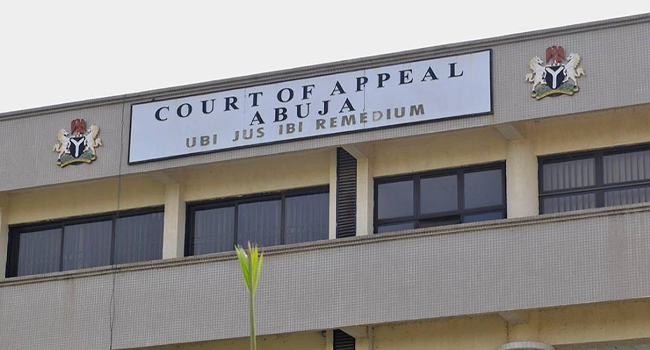
The Court of Appeal in Abuja has set aside the judgment of the Federal High Court directing the Independent National Electoral Commission (INEC) to deregister the African Democratic Congress (ADC) and four other political parties, ruling that the decision was made without jurisdiction and is therefore null and void.
In a unanimous judgment delivered by a three-member panel of justices, the appellate court held that the June 15 judgment of the Federal High Court was founded on an incompetent suit filed by the National Forum of Former Legislators (NFFL), which it described as a non-juristic entity lacking the legal capacity to institute the action.
Delivering the lead judgment, Justice Abba Mohammed ruled that there was no valid suit before the trial court to justify the consequential orders directing INEC to withdraw recognition from the affected political parties.
“There was no competent suit upon which the trial court could validly exercise jurisdiction. The order directing INEC to deregister the political parties is therefore a nullity,” the appellate court held.
The court further faulted the Federal High Court for failing to properly evaluate evidence presented by the parties, noting that documents showing the affected political parties had won elective offices in previous elections were ignored.
The appellate court also held that the trial judge acted in defiance of an earlier order directing him to suspend proceedings pending the determination of an appeal.
According to the panel, the lower court ought to have declined jurisdiction and dismissed the suit for lacking merit.
Consequently, the appellate court allowed the separate appeals filed by the affected political parties and restored their legal status as duly registered political parties eligible to participate in Nigeria’s electoral process.
The court also awarded costs against the National Forum of Former Legislators, which instituted the suit.
The parties affected by the judgment are the African Democratic Congress (ADC), Action Peoples Party (APP), Action Alliance (AA), Accord Party (AP), and Zenith Labour Party (ZLP).
Earlier Stay of Execution
The latest judgment follows an earlier decision of the Court of Appeal on June 16, which granted a stay of execution of the Federal High Court’s ruling and criticised the conduct of the trial judge.
The appellate court had accused Justice Peter Lifu of the Federal High Court of disregarding an order issued on May 22 directing him to stay further proceedings pending the determination of the appeals filed by the defendants.
The appellate panel described the judge’s action as a serious breach of judicial hierarchy.
“The trial judge deliberately ignored a valid order of this court. Such conduct amounts to judicial impertinence,” the court held.
Citing previous decisions of the Supreme Court, the panel noted that a judge who deliberately disobeys the orders of a superior court risks being considered “unfit for the bench,” adding that such behaviour amounts to “judicial rascality.”
Background
Justice Lifu had, in his June 15 judgment, ordered INEC to deregister the five political parties, holding that they failed to satisfy the constitutional requirements for retaining their registration.
The trial court also restrained the electoral commission from recognising the parties, accepting candidates nominated by them or allowing them to participate in the 2027 general elections.
The judgment arose from a suit filed by the National Forum of Former Legislators, marked FHC/ABJ/CS/2637/2026, which argued that INEC was constitutionally obligated under Section 225A of the 1999 Constitution (as amended), the Electoral Act 2022 and its own regulations to deregister political parties that failed to meet prescribed electoral performance thresholds.
The plaintiffs contended that the ADC and the four other parties failed to secure the minimum constitutional benchmarks, including obtaining at least 25 per cent of votes in a state during a presidential election or winning elective offices at the national, state or local government levels.
According to the former lawmakers, the parties performed poorly in the 2023 general elections and subsequent by-elections, making their continued recognition by INEC unconstitutional and detrimental to the integrity of Nigeria’s electoral system.
The Attorney-General of the Federation and Minister of Justice, Prince Lateef Fagbemi (SAN), who was listed as a defendant in the suit, supported the plaintiffs’ position before the trial court.
He argued that INEC had a constitutional duty to deregister political parties that failed to satisfy the requirements of the law and warned that retaining such parties would undermine electoral integrity.
However, dissatisfied with the judgment, INEC and all the affected political parties appealed the decision, urging the Court of Appeal to set it aside.
With the latest ruling, the appellate court has restored the legal status of the five political parties, clearing them to continue their political activities and participate in the build-up to the 2027 general elections unless the decision is overturned by the Supreme Court.