
Boxing, Wrestling and Weightlifting: Women in “Unfeminine” Sports By Dikko Falilat Kehinde
Boxing, Wrestling and Weightlifting: Women in “Unfeminine” Sports
By Dikko Falilat Kehinde
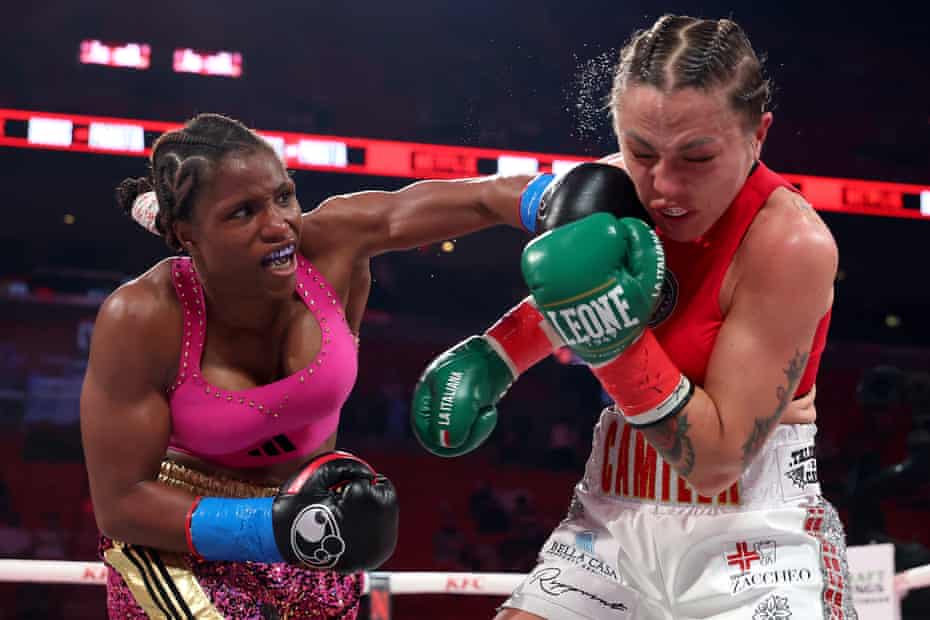
There was a time not too long ago when the idea of a woman stepping into a boxing ring or lifting a heavy barbell was greeted with raised eyebrows and whispered criticism. Society had drawn invisible lines around certain sports and stamped them “not for women.” Boxing, wrestling, and weightlifting were labelled rough, masculine, and unfeminine.

But history, like a stubborn river, refuses to flow in only one direction. Today, women across the globe are stepping into rings, onto wrestling mats, and under heavy barbells, proving that strength has no gender. They have broken barriers with their fists, their grit, and their quiet refusal to stay within society’s narrow boxes.
In the world of boxing, the rise of women fighters has been nothing short of extraordinary. Consider the story of Claressa Shields of the United States. Born in Flint, Michigan, a city known for hardship and resilience, Shields stepped into the ring as a teenager and punched her way into history. She became the first American boxer—male or female—to win back-to-back Olympic gold medals in 2012 and 2016. Later, she went on to dominate professional boxing, holding all four major world titles across multiple weight divisions. 
Her journey was not smooth. Critics once said boxing would “ruin” a woman’s femininity. Shields answered not with arguments but with victories. Like the old saying goes, actions speak louder than words, and every punch she landed echoed that truth.

Across the Atlantic, another remarkable fighter was carving her own legend. Mary Kom of India, often nicknamed “Magnificent Mary,” grew up in a humble farming family in Manipur. She trained secretly at first, fearing that her parents might disapprove of a daughter choosing boxing gloves over domestic duties. But destiny had other plans. Mary Kom went on to win the World Amateur Boxing Championship six times and became one of the most decorated female boxers in history. 
Her story reads like a proverb come to life: When determination plants the seed, success eventually grows. Even after becoming a mother, she returned to the ring and continued to win medals, proving that motherhood and ambition can walk hand in hand.
In Japan, a young boxer named Sena Irie stunned the world at the Tokyo Olympics when she won gold in the women’s featherweight category, becoming the first Japanese woman to achieve such a feat in Olympic boxing. 
Irie’s journey began at the tender age of seven, inspired by a boxing cartoon. What started as childhood curiosity blossomed into Olympic glory. It was a reminder that sometimes greatness begins in the most unexpected places like a small gym in a quiet town.
Meanwhile in Brazil, Beatriz Ferreira,nicknamed “The Beast” has earned global recognition with her powerful fighting style. She won gold at the 2019 Women’s World Boxing Championships and later claimed the IBF lightweight world title. 
Her nickname might sound fierce, but behind the punches is a disciplined athlete who trained tirelessly to rise from the streets of Salvador to the pinnacle of world boxing.
Europe has its own heroines too. Lauren Price of Wales is a multi-talented athlete who once played football before turning to boxing. She eventually won Olympic gold at the Tokyo Games and later became a unified world champion. 
Price’s journey proves that talent often refuses to stay in one lane. Like a restless wind, it moves until it finds the right direction.
Yet boxing is only one part of the story.
In wrestling, women have also turned skepticism into applause. Athletes like Saori Yoshida of Japan dominated women’s wrestling for years, winning three Olympic gold medals and becoming one of the greatest wrestlers in history. Her relentless style earned her admiration around the world.
Similarly, Helen Maroulis of the United States made history when she defeated the legendary Yoshida at the 2016 Olympics to win gold. It was a moment that echoed across wrestling arenas worldwide, reminding fans that the mat respects only skill and courage—not gender.
Weightlifting, once considered the ultimate “men’s sport,” has also seen remarkable female champions. China’s Li Wenwen lifted astonishing weights to win Olympic gold, while Nigeria’s own Blessing Oborududu and other African athletes have carried the continent’s pride onto international podiums.
When these women step onto the platform, the clanking iron tells its own story. Each lift is a declaration: strength is not masculine or feminine—it is simply human.
Yet the road to acceptance has not been easy.
For decades, critics argued that combat sports would make women “too aggressive,” while weightlifting would make them “look masculine.” These stereotypes clung stubbornly to society like dust on old furniture.
But time has a way of sweeping away outdated beliefs.
Today, female fighters headline major boxing events, Olympic arenas roar with cheers for women wrestlers, and weightlifting platforms celebrate record-breaking performances by women.
Even popular culture has begun to reflect this change. Films, documentaries, and biographies now tell the stories of women who refused to accept limitations placed upon them.
And perhaps that is the real victory, not just medals or titles, but the quiet dismantling of old stereotypes.
A young girl watching a boxing match today does not necessarily see a barrier; she sees a possibility.
In many ways, these athletes are modern pioneers. They did not merely participate in sports; they redefined them. Their courage opened doors that once seemed permanently shut.
There is an African proverb that says, “When the lion learns to write, every story will glorify the lion.” For years, sports history was written mostly by men, but today women are writing their own chapters—with sweat, determination, and sometimes bruised knuckles.
From the rings of America to the villages of India, from Japanese gyms to Brazilian arenas, women in boxing, wrestling, and weightlifting are proving a simple truth: courage does not ask permission.
They are not trying to be “like men.”
They are simply being themselves—strong, determined, and unstoppable.
And as the world watches them rise, one thing becomes clear: what was once called “unfeminine” is now simply called excellence.
Dikko Falilat Kehinde
Author and public affairs analyst,
Write from Lagos,
Nigeria.
Kehindedikko@gmail.com
07034484445